Planning & Promotion
How to Plan a Parade: The Complete Guide
Learn how to plan a parade from the first committee meeting to parade day: permits, route selection, staging, lineup order, timing, safety, and weather calls.
A parade looks effortless from the curb: units roll past at a walking pace, the crowd waves, and 90 minutes later everyone heads home happy. Getting there takes months of permits, applications, volunteer recruiting, and route work. The organizers who make it look easy are the ones who started early and worked a plan. This guide lays out the whole job in the order you will actually do it, from the first committee meeting to the debrief the week after.
The planning timeline
Start at least 6 months out for a small community parade, and give yourself a full year for anything large or brand new. Nearly every serious parade problem, from permit trouble to a half-empty lineup, traces back to a late start.
12 months out
Lock the date, and check it against school calendars, other festivals, and anything else competing for your streets and your crowd. Recruit the core committee (roles below) and build a budget with a 20% contingency line. Expect security and traffic control to be your two largest expenses, often more than half the total. This is also the window to approach sponsors, while next year's budgets are still open.
6 months out
Open unit applications and announce the parade publicly. Start the permit conversation with the city even if the formal application window has not opened; you want their requirements in hand now, not in the spring. Begin volunteer recruitment, walk the proposed route on foot, and reserve anything that sells out: portable restrooms, barricades, sound equipment, off-duty officers.
3 months out
Close applications and send acceptance notices. Finalize the traffic control plan with police and public works, file insurance certificates, and order route signage. Assign volunteers to specific roles so training can be role-specific.
1 month out
Build the lineup and send participant packets: staging map, lineup number, arrival window, and the rules. Hold volunteer training. Confirm every vendor in writing. Complete the overhead obstacle survey if you have not already, and publish your weather policy so nobody is surprised by it later.
Parade week
Send final instructions 7 days out and a short reminder 24 hours out. Watch the forecast daily. Stage barricades and signage the day before if the city allows it. On parade morning: radio checks, marshal briefing, float inspections, then step-off.
Permits and city coordination
File the parade permit 60–90 days before the event at minimum; some cities want more, and popular dates go to whoever applied first. The document the city actually scrutinizes is the traffic control plan: which streets close and when, where detours route, who places and removes barricades, and how emergency vehicles get through while the route is closed. Show up to your first city meeting with a marked map and a proposed closure schedule. It signals you know what you are doing, and it usually shortens the whole process.
You will also need general liability insurance naming the city as an additional insured, commonly $1 million per occurrence. Specialty permits apply only where they apply, but miss one and it can stop the event.
📋 Permit checklist
- Parade permit filed 60–90 days out
- Traffic control plan approved by police and public works
- Certificate of insurance on file, city listed as additional insured
- Noise permit for amplified sound, if required
- Health department permits for food vendors
- Vendor permits for merchandise sales
- Fire department approval for pyrotechnics or open flame
Ask the city for a single point of contact and invite that person on your route walkthrough. A staffer who has walked the route with you approves plans faster and flags problems you cannot see on a map, like a repaving project scheduled for the week before your date.
The committee and volunteer corps
You cannot run a parade alone, and you should not try. The core committee needs six roles: a parade director who owns the whole event, a staging chief who owns everything before step-off, a route lead who owns the marshals and the route, a volunteer coordinator, a communications lead, and a safety officer. On a small parade one person can hold two titles, with one exception: the staging chief and the route lead work in different places at the same time on parade day, so they must be different people.
For the wider volunteer corps, recruit through service clubs (Rotary, Kiwanis, Lions), church groups, high school service organizations (students need the hours), employer volunteer programs, and last year's roster if you have one. Plan for a route marshal at every intersection and every curve, at least one staging crew member per zone, and a check-in team at the staging entrance. Then recruit 10–15% more people than the plan requires, because some will not show.
Train everyone once, in person, during the two weeks before the parade. Cover their specific role, the radio protocol, the chain of command, and what to do when something breaks. Feed them on parade day and thank them publicly afterward. Volunteer retention is the cheapest recruiting you will ever do.
Recruiting and managing units
Use an online application, and make it collect what you will need later: a description of the unit, its type, its dimensions including height, how many people, vehicles, and animals it brings, whether it plays music, and a signed liability waiver. Height matters more than most first-year organizers expect. You will check every entry against your route's overhead clearances, and you cannot check a number nobody gave you.
Communicate on a fixed cadence and hold it: applications open 6 months out, acceptances at 3 months, full packets at 1 month, final instructions 1 week out, a reminder 24 hours before step-off. Between those milestones, resist the urge to send more. Units that get 15 emails skim all of them; units that get five read them.
The packet determines how smoothly staging runs. Include a route map with performance zones marked, a staging diagram showing the unit's exact position and lineup number, an arrival window, parking instructions, an emergency contact card, the weather plan, and the rules: speed, spacing, the height limit, and the candy policy.
Choosing the route
The workable range is 1–3 miles, and shorter is almost always better. A first-year parade does well at about a mile: long enough to feel real, short enough that your volunteers can cover it and your units are not exhausted at the end. Look for at least 40 feet of usable width, smooth pavement (band members are reading music, not watching for potholes), and no steep grades. Long straightaways with one or two turns beat a winding route, both for spectator sight lines and for holding pace. Plan accessible viewing areas along the route, not just at one end.
Then think hard about the ends, because they matter more than the middle. The staging end needs a wide street, parking lot, or park that can hold every unit at once with room to organize them. The dispersal end needs space for units to break down and load out without backing up into the tail of the parade. Experienced organizers often pick the staging and dispersal areas first and let the route connect them.
Staging area design and lineup order
Staging is where parades are won or lost. Design it with a single entrance, check-in at that entrance, one-way flow inside, and a clean exit onto the route. Stage units in lineup order, each on its numbered spot, so they roll onto the route in exactly the sequence you planned. That order is the interleaved mix described below, so resist the urge to physically herd all the bands into one corner and all the floats into another. Grouping by type in staging only forces your crew to weave everything back together at the start line, in the dark, under time pressure. Make the spot signs large enough to read from a moving truck, and put portable restrooms inside the staging area; units will be standing in it for up to 2 hours before step-off.
Lineup order is what keeps the whole route energetic instead of front-loaded. A parade passes each spectator once, so if you bunch all the bands together, everyone gets a wall of noise up front and a quiet march to the end. The fix is to interleave. Open with the color guard or honor guard, and place dignitaries and the grand marshal in the front third while the crowd is fresh. After that, mix deliberately: spread your loud units so no two big bands sit back to back, space the large floats so no single block gets all the spectacle, and alternate unit types rather than running five of the same in a row. A spectator standing anywhere on the route should see the same variety as someone at the reviewing stand.
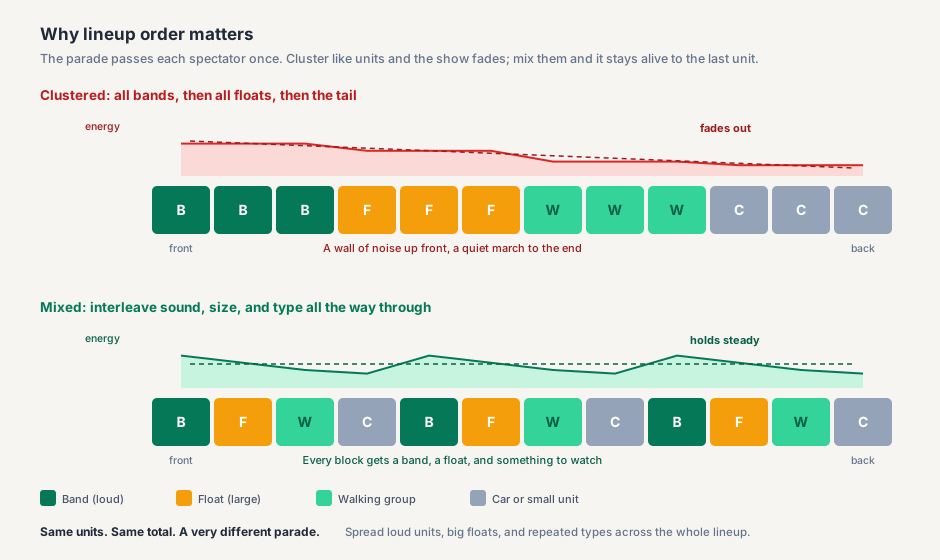
Animals are the one common exception to pure interleaving. Many parades place horses at the very back so cleanup stays behind everyone else, and that is a reasonable call. If you do, still keep them clear of the loudest unit ahead of them, staff them properly (one handler per horse or large animal, plus one cleanup person for every 2–3 animals), and give them a quieter corner with water access at staging.
💡 Pro Tip: Lock the order before you print the numbers
Number units sequentially, 1 through however many you have, and treat the order as fluid until the week of the parade. The expensive mistake is printing lineup number signs early, because every late entry after that either forces a reprint or a renumber. Once the order is locked, print. If one more unit shows up after that, give it the previous unit's number with a decimal or a letter (12.5 or 12A) so it slots in without moving anything else.
Parade day operations and communications
Run the day from a command post at the staging area, staffed by the parade director with a copy of every plan, roster, and phone number. Communications run on radios, not cell phones, because cell networks jam when a crowd gathers. Use two channels: an operations channel for staging, marshals, and timing, and a separate channel reserved for safety and medical. Train everyone to identify themselves and keep transmissions short.
Control the start line. One person releases units onto the route at a fixed interval; units never self-launch. A pace vehicle at the front holds the parade to 2–3 mph. Marshals along the route report gaps, breakdowns, and medical calls by radio. Establish before the parade that only the director or the safety officer can halt the event, and make sure every marshal knows it.
Position first aid at the staging area and at least one point mid-route, and keep one traffic lane or a parallel street clear for emergency vehicles for the entire event. The city will require that in the traffic plan. Your job is making sure it stays true once the parade is rolling and the crowd is at its thickest.
Safety fundamentals
Most parade safety is unglamorous discipline. Barricade every intersection. Keep spectators behind a defined curb line with a buffer from moving units. Inspect every float on parade morning: brakes, hitch pins, driver sight lines, and a fire extinguisher aboard. Riders stay seated or secured, and no one mounts or dismounts a float in motion, ever.
⚠️ Warning
Never allow candy to be thrown from a moving float. Children chase it under the wheels. Put walkers at the curb line to hand it out instead, and write the rule into every unit packet with a one-strike enforcement policy.
The other quiet hazard is overhead clearance. Survey the entire route for power lines, tree limbs, traffic signal arms, banners, awnings, and bridges. Record the lowest clearance you find, then set your parade height limit at least 3 feet below it. Check every application against that limit, and give extra scrutiny to the usual offenders: boats on trailers with masts up, fire apparatus, agricultural equipment with tall exhaust stacks, and floats with oversized props.
Timing and gap control
Ask spectators what ruins a parade and the answer is gaps: long dead stretches where nothing goes by. Gap control is arithmetic plus discipline. Hold units to 2–3 mph with 50 feet of spacing. Cap performance zone stops at 30–60 seconds and put a marshal with a stopwatch at every zone, because a band that stops for 3 minutes opens a quarter-mile hole behind it.
When a gap opens anyway, close it from the front: slow the pace vehicle and let the parade compress. Never rush a band; they cannot march faster than their tempo. Build a 15–20% buffer into every published time so one delay does not cascade into the street reopening deadline.
Duration is arithmetic too. At a 30-second launch interval, 80 units take 40 minutes to pass any fixed point, before performance delays. Keep the show at any given spot in the 60–90 minute range. Past that, crowds thin out no matter how good the units are.
Weather contingencies
Write your weather rules before you need them. Clear the route if lightning strikes within 10 miles, and do not resume until 30 minutes after the last strike. Ground inflatables and hold tall floats when sustained winds pass 25 mph, even if the rest of the parade steps off. In heavy rain, the call is about driver visibility and road surface. In heat, add water stations, shift step-off earlier, and watch the bands: wool uniforms in 90-degree sun is a medical call waiting to happen. In serious cold, shorten the route or the performance stops.
The decision process matters as much as the criteria. Announce in advance who makes the go/no-go call and by what time on parade morning. Pre-approve a rain date with the city when you file the original permit; adding one afterward means a second permit process. When you make a weather call, push it everywhere at once: email and text to every unit, social channels, the website, local radio. And state your refund or rollover policy on the application itself, so nobody is arguing about it in the rain.
After the parade
Hold the debrief within 48 hours, while details are fresh and before everyone scatters. Send units and volunteers a short survey, five questions or fewer, and pull the numbers that matter: actual step-off against published time, total duration, incident reports, unit no-shows, and volunteer no-shows. Then write the after-action file for next year's organizer, even if that organizer is you: what broke, which vendors delivered, what the timeline should say next time. Send thank-you notes to volunteers and sponsors within the week. Next year's parade gets staffed by how this year's people were treated.
First-year mistakes to avoid
Every one of these comes from a real parade, and every one is preventable. Starting too late is the root mistake; it forces every other compromise. Treating the permit as a formality is next, because the traffic plan negotiation takes weeks, not days. Under-recruiting volunteers leaves intersections unmarshaled and staging chaotic.
On the operations side: assuming units will pace themselves guarantees gaps, since gap control needs a plan and assigned people. Skipping the overhead survey works right up until a mast meets a power line. Dumping every instruction on units in one giant email the week before guarantees nobody reads it. Having no announced weather decision process turns a rainy morning into a rumor mill. And skipping the debrief means paying full price to relearn all of this next year.
Frequently asked questions
How far in advance should you start planning a parade?
Start at least 6 months out for a small community parade and 12 months for a large or first-year event. Permit applications alone typically must be filed 60–90 days before the parade, and vendors like barricade and restroom companies book up months ahead.
How long should a parade route be?
Most parades work best between 1 and 3 miles, and a first-year parade should stay near 1 mile. Look for at least 40 feet of street width, smooth pavement, no steep grades, and room at both ends for staging and dispersal.
What permits do you need to hold a parade?
At minimum you need a parade or special event permit, an approved traffic control plan, and a general liability insurance certificate naming the city as additional insured. Depending on the event, add noise permits for amplified sound, health permits for food vendors, and fire department approval for pyrotechnics. File 60–90 days ahead.
How many volunteers does it take to run a parade?
Plan for a route marshal at every intersection and curve, at least one staging crew member per zone, a check-in team, and first aid coverage. For a typical small community parade that lands between 25 and 50 volunteers. Recruit 10–15% more than the plan calls for to cover no-shows.
How fast does a parade move?
A parade moves at 2–3 mph, a comfortable walking pace, with about 50 feet between units. Performance stops should run 30–60 seconds each. At those numbers, an 80-unit parade takes roughly 40–50 minutes to pass any single point on the route.